Mosquito Shield of Long Island & Westchester County, NY.
How real-time fleet visibility helped a growing franchise scale with confidence
For home service businesses, growth creates a familiar tension: the more vehicles and technicians you put on the road, the harder it becomes to maintain consistency, accountability, and service quality.
That was the challenge facing Ohavia Feldman, Owner of Mosquito Shield of Long Island & Westchester County, NY.
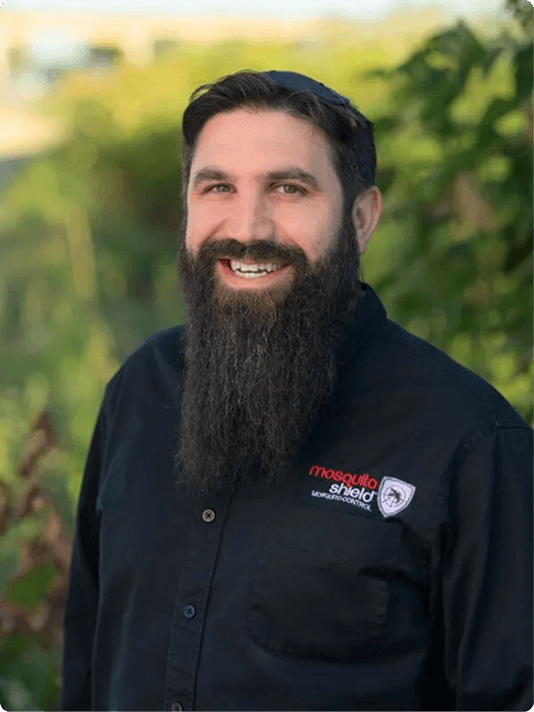
“Before EYERIDE, we faced a real lack of confidence and visibility into our drivers. We had no clear answers to the questions that mattered most: Were they driving safely? Were they parking smart? How were they interacting with our biggest assets - our vehicles and equipment? Without that visibility, we were essentially operating on trust alone, with no way to verify what was actually happening in the field.”
Ohavia Feldman, Owner of Mosquito Shield of Long Island & Westchester County, NY.
For a business that depends on technicians completing routes accurately, representing the brand professionally, and delivering consistent service across a high volume of stops, that gap matters. It affects dispatch, customer trust, safety, liability, and the ability to scale.
Why EYERIDE stood out
When evaluating solutions, Mosquito Shield of Long Island was looking for more than standard Telematics. They needed a platform that could show them what was really happening, in real time. EYERIDE stood out for its combination of adaptive live streaming, multiple in-vehicle cameras, second-by-second cloud uploads, and an easy-to-use dashboard. But the deciding factor went beyond product features.
“What really sealed it was seeing that EYERIDE isn't just constantly improving - they're improving ahead of the rest of the industry. They're not catching up to anyone; they're setting the pace.”
That forward-leaning approach mattered to a growing operator that needed a solution built not only for today’s needs, but for the realities of expansion.
From assumptions to verification
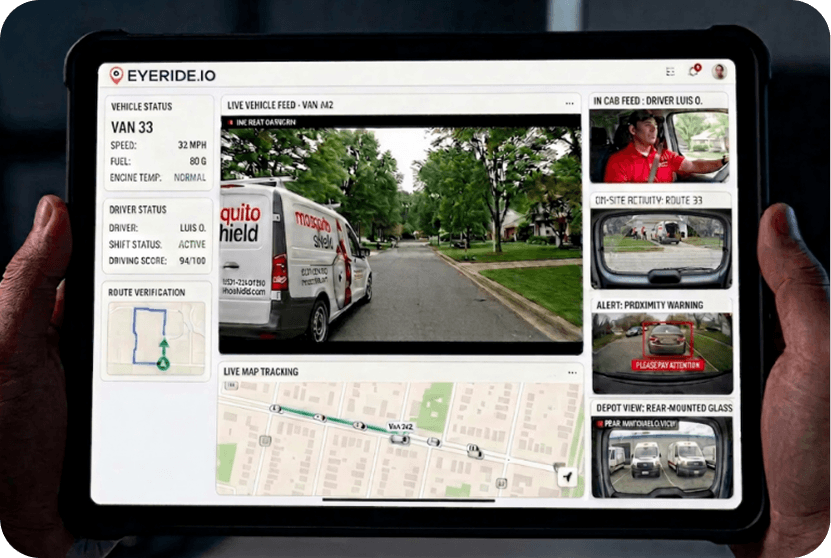
One of the most powerful changes came from EYERIDE’s integration of camera systems, map data, and proprietary Telematics HW.
“Our camera systems are tied to door sensors, which has been a game-changer. We can see exactly where on the map a technician stopped and got out of the vehicle, and we can pull up the footage of that exact moment. The combination of map data and synchronized video gives us complete confidence that every property on the route was actually visited and serviced.”
That level of verification is especially valuable for route-based service businesses. It changes oversight from a reactive process into a proactive one. Instead of wondering whether work was completed, managers know.
From customer complaints to fact-based conversations

For service brands, customer trust is built or lost in the moments when something goes wrong. A missed stop. A disputed visit. A complaint about quality. Without evidence, resolving those situations becomes guesswork.
EYERIDE gave Mosquito Shield of Long Island the ability to verify field activity in real time and respond with confidence.
“We're able to watch many of our techs go about most of their work in the field, which means we can perform a live audit at any time. That changes the entire conversation with customers. Instead of hoping we're delivering quality, we can tell them with certainty: we know we're doing a great job, and we know our techs are performing at the level we promise.”
As Ohavia explains, that confidence carries directly into the customer experience. For franchise operators and home service fleets alike, this is a critical shift. Visibility does not just improve operations behind the scenes. It strengthens brand credibility in the field.
Staying in control during peak season
Seasonal surges are where operational systems are truly tested. In peak periods, route density increases, dispatch decisions become more dynamic, and technician accountability becomes harder to maintain.
Mosquito Shield of Long Island found that EYERIDE helped them manage growth without adding chaos.
“When peak season hits, EYERIDE keeps us running tight. Real-time visibility into where every vehicle is, combined with route verification through our door-sensor and camera integration, means dispatch can make smart decisions on the fly. Technician accountability is built in - everyone knows their work is visible - so we can scale up the volume without scaling up the chaos.”
Just as importantly for a seasonal business, EYERIDE supports Mosquito Shield from a financial perspective as well. During the off-season, when operations are closed and vehicles are not actively generating revenue, EYERIDE does not force the business to carry the same full operating cost. Instead, Mosquito Shield is charged only a basic maintenance cost while the fleet is inactive. That flexibility makes EYERIDE especially well-suited for seasonal franchise operators.
Safer driving, lower risk, stronger accountability
Route-based service businesses also face another constant challenge: driver behavior.
With technicians making dozens of stops a day, unsafe driving, phone distraction, speeding, and harsh braking create real liability exposure. EYERIDE’s AI-powered safety alerts helped Mosquito Shield of Long Island address those issues directly.
“We get notifications the moment there's unsafe driving - cell phone use, no seat belt, hard braking, speeding - and just as importantly, the techs get notified too. They know excellence is expected. That awareness alone shifts behavior in a way that nothing else has.”
The impact was immediate and cultural, not just operational. In the early months after implementation, one result stood out:
“Less speeding, almost immediately. And just as valuable - no more arguments about how someone is driving. The footage and data settle every conversation before it can turn into a debate.”
Backing up the brand promise
Mosquito Shield markets itself on doing the job right, with no shortcuts. EYERIDE gave the team a way to operationalize that promise.
“Our standard isn't a marketing slogan - it's something we can verify, every day, at every stop. When we say we don't take shortcuts, we have the footage and the data to prove it.”
That is where operational technology becomes a brand asset. It allows a service business to substantiate its promises instead of merely making them.
As Mosquito Shield of Long Island continues to expand, EYERIDE remains part of the growth engine and for fast-growing field service businesses, that is the real prize: scaling without losing control, or as Ohavia summarizes: